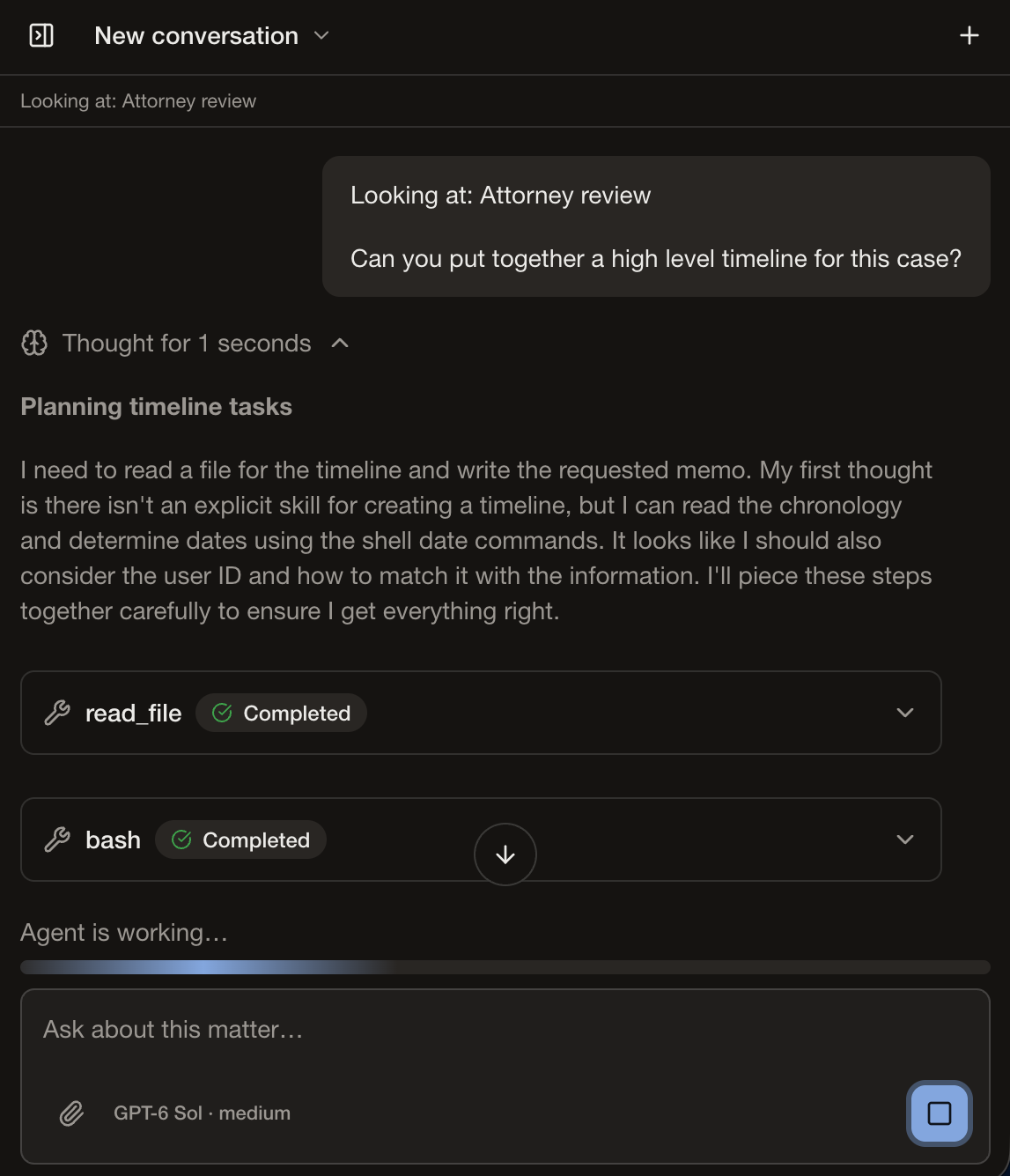
ChatEQ codes large document piles against a protocol your lawyers sign. Privilege stays flagged. Mixed files go to a human. Every verdict leaves a trail — what the model saw, why it coded that way, and which request it hit.
The protocol is yours. The pile is ours to code.
Firms do not just review what the other side dumps. They also have to produce. ChatEQ is built for both jobs — and it never mixes the two piles.
They served you thousands of files. We inventory, extract, and code against the requests that matter to your case — so attorneys spend time on privilege, mixed documents, and the uncertain remainder, not the obvious no.
You agreed to produce a defined set of requests — not everything they asked, and not other deals sitting in the same files. We code the client dump against signed responses, then flag redaction and withhold-privilege before anything ships.
Counsel protocol never walks into the production dump
Rubric, privilege screen, and glossary before classify
The model shrinks the pile. Counsel owns the hard calls
A fifteen-thousand-file dump is not a reading assignment. Missing privilege is worse than over-producing. And if opposing counsel or the court asks how you coded, “the AI looked at it” is not a methodology.
Most files are obviously out. The cost is finding the few that are in, privileged, or mixed with other deals.
Responsive and privileged is still a withhold. We never let a produce call wash out a privilege flag.
This dispute plus another deal is not “produce the whole PDF.” It is redaction — or a human queue until it is.
A model that “iterated” cannot be described to a court. A resumable loop with a versioned rubric can.
Elusion on the “not responsive” set. Precision on the “responsive” set. Then tighten the protocol and re-run.
“This is LLM-assisted review, not a replacement for attorney judgment. Counsel owns the hard calls, the privilege log, and the sample that makes the method defensible.”
A deterministic pipeline. Same method every time. Resume if it stops. Re-run when the rubric changes.
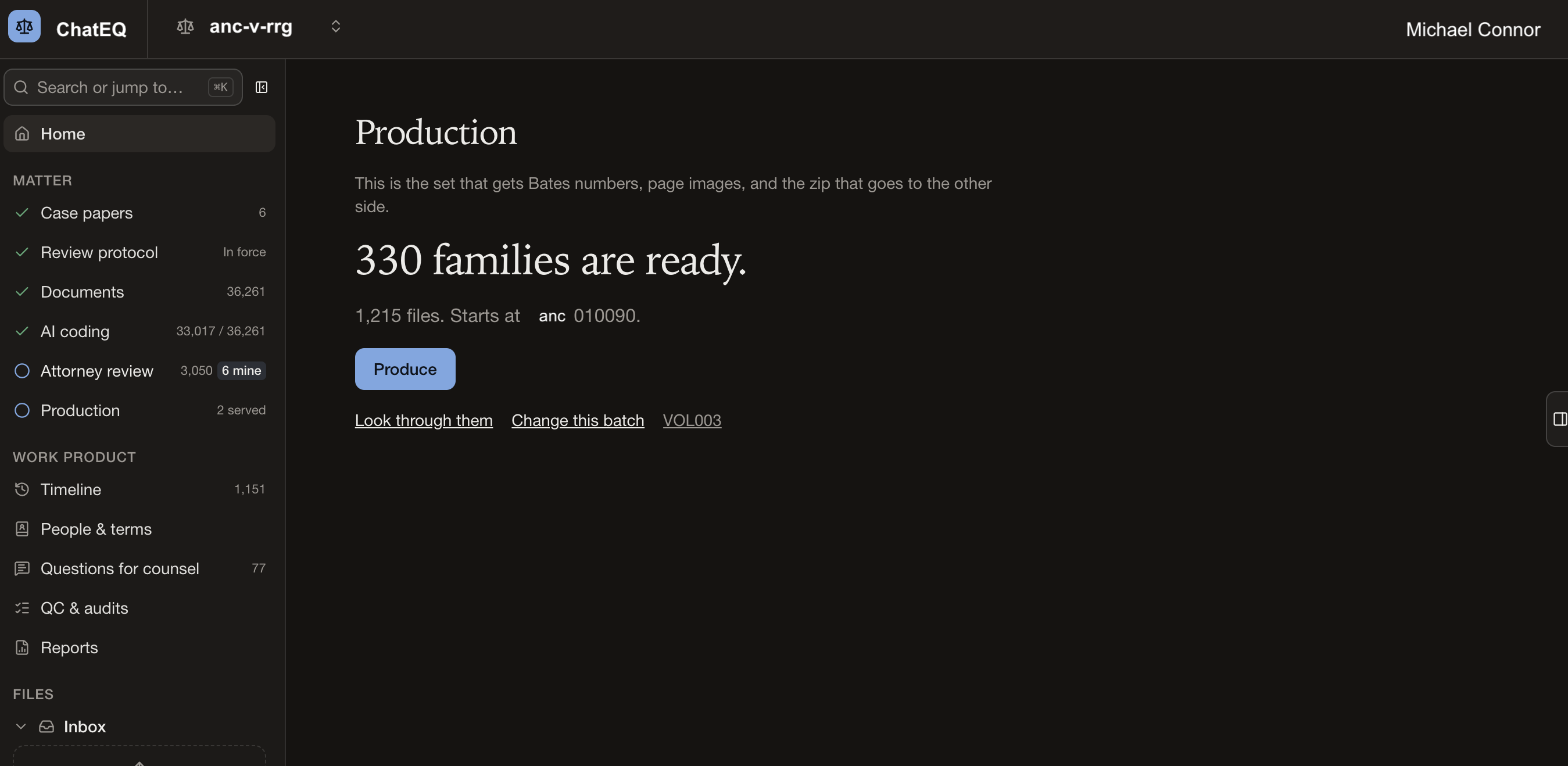
Pleadings and RFP responses become a rubric, a privilege screen, and a glossary. Attorneys edit and sign. Classify does not start on a stub.
Originals are never mutated. Every file is hashed, deduped, and converted to a working-text layer. Emails review as families.
A cheap model codes the pile. A frontier model re-reviews uncertain, privilege, and extract-fail. Structured verdicts — not a chat transcript.
Human queues for privilege, redaction, and leftover uncertainty. Sample the yes and the no. Export a report the firm can stand behind.
ChatEQ is not a chatbot improvising over client files. It is a batch loop with an escalation ladder: same classify function, different model, checkpointed by content hash. Long documents map over page windows so a buried hit is not lost in a 40-page dump.
Tier 1
Fast model across every family
Structured verdict, confidence, matched requests, excerpts
Tier 2
Frontier model on the scared set
Uncertain, privilege, extract-fail, borderline
Human
Counsel queue + QC sample
Privilege log, mixed-deal redaction, elusion / precision
Discovery files are the client’s life. We treat them that way — isolation by matter, encryption by default, and a paper trail for every call.
Encryption in transit and at rest. One sandbox per matter — Client A’s files are never mounted next to Client B’s. Conversion stays local. The only egress is a review call the firm has approved. NDA and provider green light before any real document hits a model.
Each document stores reasoning, key excerpts, matched RFP numbers, privilege flag, confidence, model id, and a hash of the signed protocol. If the rubric changes, the hash changes. You can say exactly what the system saw.
Client documents do not train our models. Paid API providers are selected for zero-retention options. If the firm needs everything inside an existing AWS or GCP agreement, we run on Bedrock or Vertex instead.
Same prompt version. Same schema. Same signed files. Repeatable, resumable, audited. That is what makes technology-assisted review defensible — not a story about an agent that figured it out.
A briefing is enough to start: the requests you agreed to produce, a privilege screen, and a sample of the dump. We will tell you what the pipe will do before a single file hits a model.